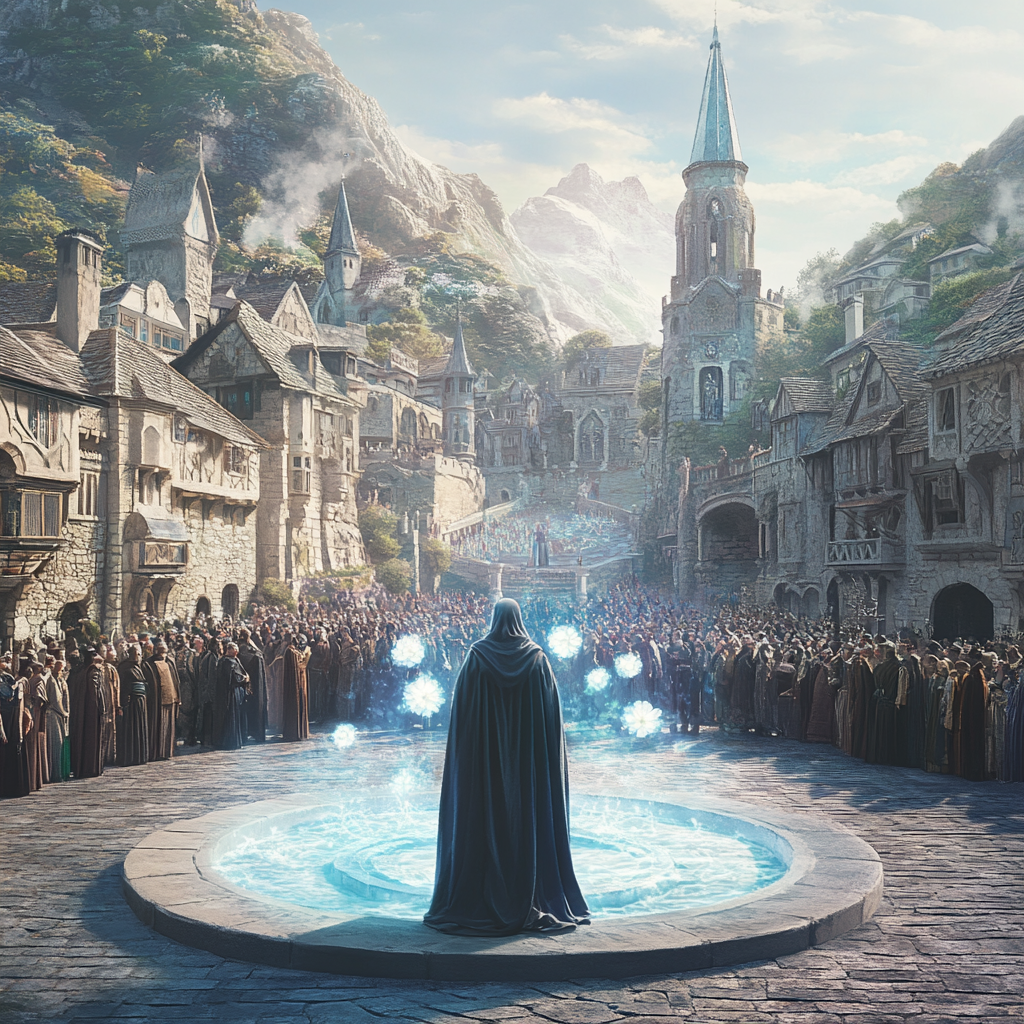
CENTRAL MARKETPLACE - In Skalunda, ritual isn't merely tradition—it's the heartbeat of society, the visible manifestation of an invisible contract between the governed and their guardians. Yesterday, on Omnial Blessing Day, the Registry Allocation Ceremony exemplified this relationship in its most concentrated form, as citizens from every district gathered beneath the watchful eyes of those who maintain the great machinery of their prosperity.
High Seidr Amalric stood elevated above the crowd, his blue robes catching the morning light as he raised his ceremonial staff. The crowd fell into a hushed reverence that comes not from fear, but from generations of conditioned gratitude. "The harmony of the vectors flows eternal through Skalunda," he intoned, his voice carrying across the plaza with practiced resonance. "Through the wisdom of the Founders and the vigilance of your Council, prosperity continues uninterrupted as it has for generations."
Lines of expectant citizens snaked through Skalunda's Central Plaza, their faces illuminated by the soft blue glow of the Registry Stone as it dispensed this cycle's Omnis. The crowd was larger than any in recent memory, with citizens arriving before dawn to secure favorable positions.
Citizens performed the familiar invocation gestures, palms pressed against the crystalline interfaces while reciting the traditional phrase: "Omnivecti distributus, vis et fluxus." The ritual, performed countless times across generations, connects each Skalundan to the system that has sustained our society since its founding.
Yet this year's ceremony was not without anomalies. When Amalric commanded Roselian flowers to materialize, something unprecedented occurred. The flowers hesitated at the threshold between non-existence and being, arriving seconds late and wrapped in a luminescent blue halo never before witnessed in living memory. For a brief moment, uncertainty flickered across Amalric's face—a microexpression of concern quickly replaced by benevolent confidence.
During the ceremonial demonstration, when Omnivectician Ludovico Valsten requested a gilded ceremonial vessel – traditionally manifested flawlessly to demonstrate the system's precision – the item failed to materialize entirely. The officiating Seidr quickly covered this unprecedented failure by suggesting "unworthiness" in the requester, though such rejections were virtually unheard of in previous ceremonies.
The Registry Stone emitted a subtle high-pitched hum when activated, something entirely new that most adults seemed not to notice but caused several infants to wail inconsolably.
"Minor fluctuations are natural during peak usage periods," explained Omnivectician Terric Kelvidar when asked about these irregularities. His hands moved with practiced precision across the Registry Stone's surface, performing what appeared to be ritual adjustments. "The Omnivectus responds to the collective energy of Skalunda, and such a large gathering naturally creates harmonic variations."
In the Noble Quarter, residents dismissed reports of similar fluctuations in lower districts with the casual authority of those accustomed to perfect service. "The harmonics simply require recalibration," explained Registry Keeper Valens, wielding magical terminology with confident imprecision. Her statement revealed how Skalunda's social hierarchy reinforces itself—those closest to power inherit not just privilege, but the language to rationalize that privilege.
Citizens from the Residential and Artisan Districts reported that the materialization was accompanied by an unusual metallic taste – something never experienced in previous ceremonies. "It's like licking a copper Registry token," described one confused citizen, quickly adding, "Not that I would know what that tastes like."
One elderly woman, observing from the edge of the plaza, whispered to her grandson something that caught this reporter's attention: "The Vectors are misaligning." When questioned about this unusual phrase, she claimed it was merely an old saying from her grandmother's time, though she could not explain its meaning.
As the ceremony concluded, citizens returned to lives built around the certainty of the Omnivectus. They carried with them both the visible symbols of prosperity—manifested goods and allocated resources—and the invisible reassurance that comes from believing in systems too complex to understand but too essential to question.
In this way, Skalunda's celebration of prosperity reveals the intricate dance between protection and control, between genuine care and necessary illusion. The Council watches, and the citizens, feeling watched over, celebrate. Another cycle continues, another blessing bestowed—even as subtle signs suggest that the machinery behind the magic may not be as eternal as its stewards proclaim.